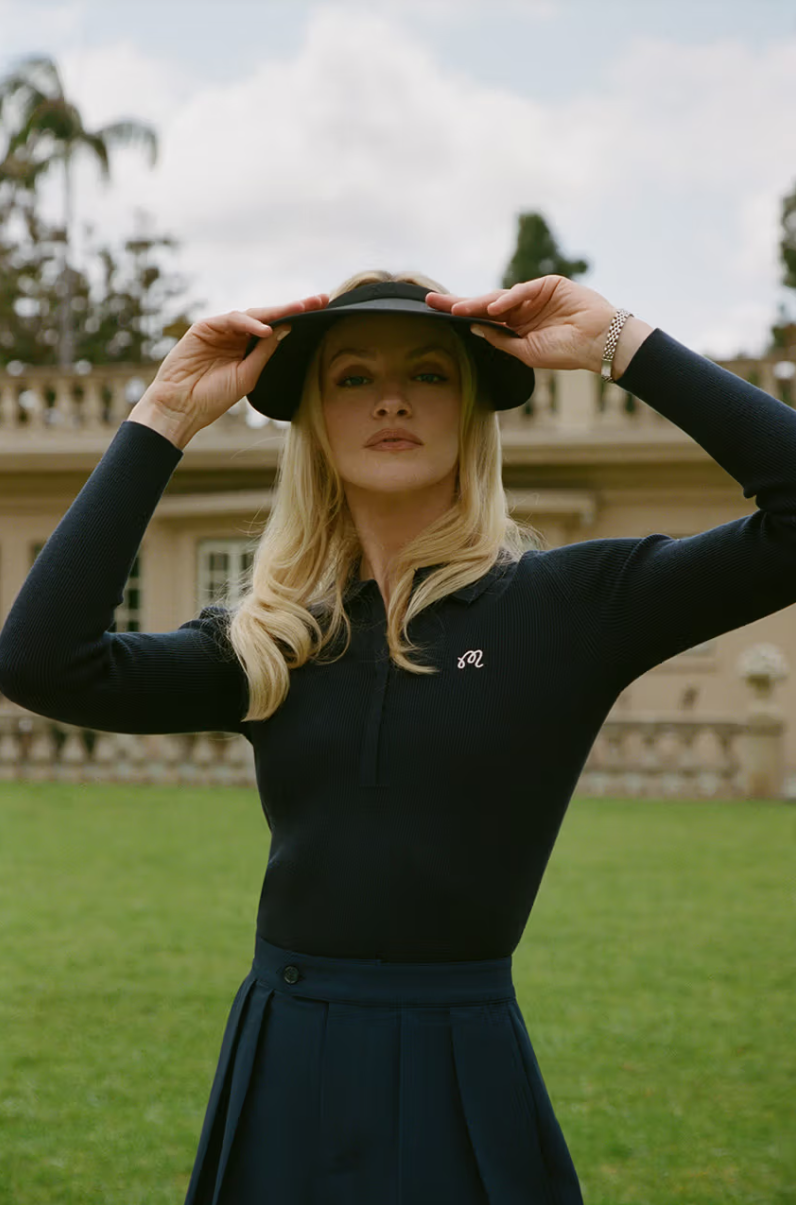
She organises the academies, books the travel, chooses the kit, and controls the family golf spend. She is entering her peak decade. The industry has not yet understood who it is actually selling to.
There is a moment I have watched repeat itself at junior golf tournaments across Malta and the wider Mediterranean region. It happens in the car park, usually around eight in the morning, when families arrive for a competition day.
The fathers step out in immaculate kit. Branded polos, well-fitted trousers, the right shoes for the right conditions. They have given this some thought.
The mothers — who have in most cases organised the entire day, booked the travel, packed the bags, confirmed the academy places, and negotiated the morning departure with a household that would rather still be asleep — stand at the edge of the fairway in whatever they could find that was vaguely appropriate. A high street pair of chinos. A sports top that almost works. Trainers that will do, technically, but wouldn’t be anyone’s first choice.
Not because they don’t care how they look. Not because they have no interest in the sport. But because nobody has designed a wardrobe for them. The market, for reasons that are genuinely difficult to explain given the data, has not yet decided that this woman is worth dressing properly.
I know this not only because I have stood in that car park myself, with a twelve-year-old and a seven-year-old in tow, but because I volunteer as a junior golf academy coordinator and organise regional golf travel across the Mediterranean. I have had versions of this conversation with women in Portugal, Spain, Sweden, and across the Maltese islands. The geography changes. The wardrobe problem does not.
Golf has an aesthetic gap. Not a participation gap — the participation numbers, as we will see, are extraordinary. An aesthetic gap. A failure of imagination by an industry that has spent decades designing for one kind of golfer and is only now, slowly, beginning to understand who actually shows up on a Tuesday morning with a child who has a 7am tee time.
Diana Suke
The Numbers Behind the Overlooked Consumer
Before we talk about aesthetics, let us talk about scale. Because the case for taking the golf mother seriously as a consumer is not sentimental. It is mathematical.
According to the R&A’s 2024 Global Participation Report — the most comprehensive study of golf participation produced by the sport’s governing body — there are now 108 million adults and juniors playing golf globally across all formats. Europe alone accounts for 20.3 million adult players. More significantly for our purposes: Europe has 18.5 million junior golfers, the largest junior participation base on the planet.
Read that figure again. Eighteen and a half million young people playing golf across European countries, each one connected to a family that is making purchasing decisions, travel decisions, academy decisions, equipment decisions on their behalf.
In the overwhelming majority of cases, the person making those decisions is the mother.
This is not an assumption. It is consistent with what we know about household spending in sports and leisure. Research from the golf sector confirms that the 35–50 female demographic drives the highest apparel spend per head in women’s golf. And according to the same R&A data, women now represent 31% of adult golfers in the sport’s nine key markets — a proportion that has grown steadily for a decade and shows no sign of reversing. Among alternative golf formats — driving ranges, indoor simulators, adventure golf — women account for 50% of all adult participants. She is not a niche player approaching the edge of the sport. She is already in the middle of it.
The global women’s golf apparel market reflected this belatedly. Valued at approximately $1.5 billion in 2025, it is projected by multiple independent analysts to reach between $1.85 billion and $4.25 billion by 2034–2035, depending on the methodology applied. The spread in those projections matters less than the direction: every analyst agrees on growth, and every analyst agrees that the women’s premium segment is expanding faster than the mass market. Mordor Intelligence reports the premium golf apparel tier growing at a CAGR of 6.77% — the fastest of any segment in the category.
The demand exists. The purchasing power exists. The participation exists. What has not kept pace is the supply of products that take this consumer seriously.
What She Actually Wants
Here is what I have learned coordinating junior golf travel, and what the data confirms: the golf mother is not looking for sportswear. She is not looking for fashion. She is looking for something the market has been slow to name — considered dressing for a life that moves between contexts.
On a tournament day, she may go from a 6am breakfast with a nervous twelve-year-old, to ninety minutes on a golf course in variable Mediterranean weather, to a club lunch where she will sit across from academy directors and other parents, to a school pickup that afternoon, to a dinner reservation that evening. The outfit she chooses at 5:45am has to work across all of it, or she changes — which is a luxury not everyone has, and not always possible when you are travelling.
This is why the hybrid course-to-casual category has become the fastest-growing design segment in women’s golf apparel. In 2024, approximately 40% of all new women’s golf apparel collections launched by major brands featured designs intended to work both on and off the course — golf dresses, performance trousers with clean lines, layering pieces that read as intentional in a clubhouse and not absurd in a restaurant. The market is catching up to a reality that every golf mother has been navigating for years without a proper wardrobe.
What the market is still missing is curation. The pieces exist, scattered across pro shops, sporting goods websites, and a growing number of direct-to-consumer golf brands. What does not exist — at least not in Europe, at least not yet — is a trusted editorial voice that assembles these pieces into a coherent wardrobe for this specific life. A voice that understands what it means to pack for three people for a four-day junior golf trip, and still want to look considered when you arrive.
That is the gap I am building this platform to fill.
The Aesthetic She Deserves
There is a particular kind of woman I encounter repeatedly through the academy network and golf travel — the one you notice on the course not because she is dressed loudly, but because she is dressed precisely. Everything fits. Everything is considered. She looks as though she planned this, which she did, even if that planning happened in ten minutes at dawn while the rest of the house was still asleep.
That quality — call it earned elegance — is what the best women’s golf apparel is beginning to understand, and what the worst of it still entirely misses. Not the performative athleticism of mainstream sportswear. Not the country-club stiffness of traditional golf fashion. Something more deliberate: precise cuts, restrained colour palettes, technical fabrics that move correctly and look intentional. An outfit that communicates that you belong here, that you take the sport seriously without taking yourself too seriously.
This is, not coincidentally, almost exactly the aesthetic philosophy driving the Korean golf fashion movement that is beginning to reach European markets. Brands like ANEW — founded in 2018 with the explicit intention of creating “modern and sophisticated golf wear that anyone would want” — and WAAC, whose technical precision sits beneath a more expressive surface identity, understand intuitively what European women’s golf fashion has been slow to articulate: that the female golfer is a complete person with a complete aesthetic life, and her golf wardrobe should reflect that.
The quiet luxury movement in fashion more broadly is relevant here too. Research published in the Arc Journals in 2024 (Kooli et al.) confirms that the appeal of quiet luxury among consumers is primarily rooted in minimalist aesthetic values — quality of material, absence of visible branding, timeless construction over trend-driven design. Consumer data from Radial’s independent survey found that 78% of consumers prioritise high-quality materials when purchasing clothing, 56% seek timeless styles, and 43% specifically prefer logo-free or minimally branded design.
Golf, at its best, already lives in this register. The course is not a place for noise. The women who understand this — who show up in technically excellent, aesthetically restrained, perfectly fitted clothes — are not invisible. They are the ones you remember.
The Coordination Economy Nobody Has Named
There is a dimension to this that goes beyond apparel, and I want to name it because I do not think it has been written about clearly anywhere in the golf world.
The golf mother is not just a consumer of clothing. She is the coordinator of an entire ecosystem of decisions — and nobody is currently serving that coordination function with any intelligence or elegance.
She chooses the junior academy. She researches it, compares programmes, speaks to coaches, considers travel logistics, evaluates the competitive environment for her child’s current level. In Malta, where I volunteer, this decision involves balancing the quality of local provision against the case for sending a promising junior abroad — to academies in Portugal, Spain, the UK, Sweden — for development camps and competitions. These are not small decisions. They involve significant time, significant money, and significant emotional investment.
She organises the golf travel. The flights, the accommodation, the tournament registration, the equipment transport. She navigates customs with golf bags. She finds the nearest course to the hotel. She builds the schedule around her child’s competitive calendar while managing whatever else her own professional life requires — and if you are a business transformation director reporting to a CEO, as I am, that professional life is not light.
She buys the kit — for herself, and for her children kitted out in their academy uniforms. She chooses the golf accessories, the travel bags, the training equipment. She books the golf holidays that the family takes together.
And she does all of this without a single platform, resource, or community specifically designed to help her do it well.
This is the coordination economy that European golf has not yet addressed. The academy directories are fragmented. The travel information is generic. The apparel guidance doesn’t exist. The community — the network of women navigating exactly this life — is informal, person-to-person, dependent on who you happen to know at the club.
This is what building a golf family lifestyle platform is actually about. Not just fashion. The fashion is the entry point — the most immediately visible gap, the most searchable topic, the most obviously underserved category. But the real value is in becoming the trusted resource for this entire coordination layer. The woman who knows which academies are worth the investment. Which tournament trips are worth the logistics. Which brands actually understand her life.
Trust, in this context, is built through specificity. Not “here are some golf outfits.” Here is what I packed for a four-day junior competition in Vilamoura in October, and why. Here is how I evaluated two Portuguese academies for my son’s development year. Here is the Korean golf brand that produces the only skort I have found that works for nine holes in thirty-degree heat and a clubhouse lunch in the same afternoon.
That specificity is irreplaceable. It cannot be generated by a content farm, an algorithm, or a brand with a marketing budget and no operational experience inside the world it is describing.
What Comes Next
The golf mother is not an emerging demographic. She is already here, already spending, already making the decisions that shape golf’s future — because the junior golfers she is raising and supporting are golf’s future. The sport grows or contracts depending on whether families find it accessible, affordable, and culturally welcoming enough to commit to.
Getting her wardrobe right is, in this context, not a trivial concern. It is a signal. When a sport makes a woman feel considered — when she can find, without significant effort, an outfit that reflects her actual taste and works for her actual life — it tells her something about whether the sport sees her. Clubs that have understood this have seen their female membership grow. Brands that have understood this have seen their market share expand in the fastest-growing segment.
The ones that haven’t — the pro shops still stocking the afterthought corner, the brands still producing resized men’s cuts and calling them a women’s collection — are not just missing a commercial opportunity. They are telling a very capable, very well-resourced, very influential woman that she is an afterthought.
She has noticed. And she is beginning to shop accordingly.
[Your Name] is the founder of [Platform Name], a volunteer junior golf academy coordinator in Malta, and regional golf travel organiser across the Mediterranean. A business transformation director at one of Europe’s largest gaming operators and mother of two, she came to golf alongside her children and built this platform because the one she was looking for didn’t exist.
Explore the platform: [Platform name and categories]
Sources and further reading
- R&A Global Participation Report 2024 — The R&A, July 2024
- Women’s Golf Apparel Market Analysis 2025–2034 — Mordor Intelligence / Market Growth Reports
- Golf Apparel Market Size, Share and Forecast 2025–2030 — Mordor Intelligence
- Women’s Golf: Driving Growth, Inclusion and Cultural Change — Yonder Consulting, 2025
- Investigating the Consumer Purchase Motivation of Quiet Luxury — Kooli et al., Arc Journals, 2024
- Quiet Luxury or Fast Fashion: Consumers Are Buying Both — Radial Consumer Survey, 2024
- ANEW Golf — brand positioning and founder interviews — Golf Asia, December 2024