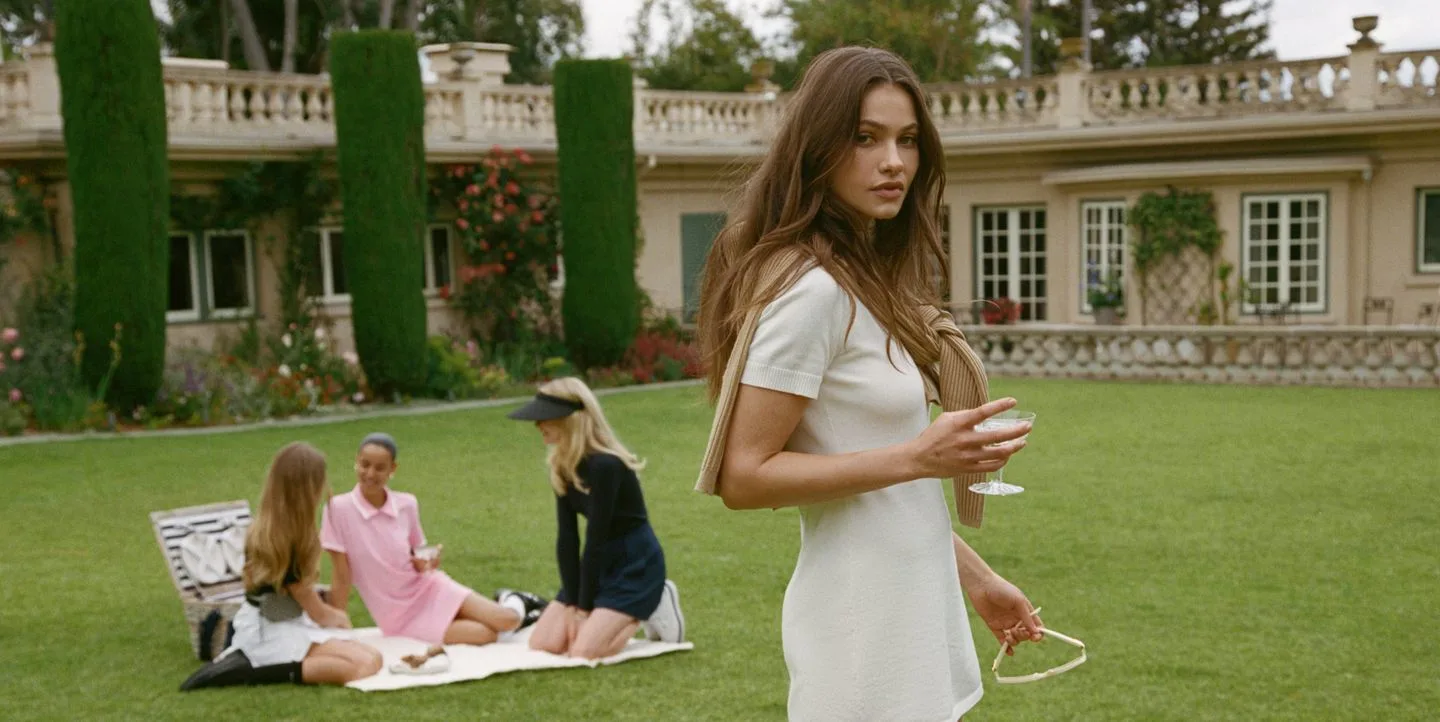
There is a woman I see at tournaments who I have never once been able to immediately identify what she is wearing. Her clothes are always correct — seasonally appropriate, technically suited to the conditions, clearly expensive without being obviously so. The palette is restrained. There are no visible logos. Nothing is trying. She plays well, moves through the clubhouse without announcing herself, and leaves a stronger impression than anyone else in the room.
I asked her once, on a long walk between holes at Aloha Golf Club in Marbella — January 2026, the light flat and warm in the way the Andalusian coast manages even in winter — how she thought about her golf wardrobe. She paused for a moment in the way that people do when they have never had to articulate something they have always known instinctively.
“I want to look like I belong here,” she said. “Not like I’m trying to belong here.”
That distinction — between belonging and trying to belong — is the entire philosophy of quiet luxury expressed in a single sentence. And the golf course, I would argue, is its most natural and revealing environment.
What quiet luxury actually means — precisely
The term circulates widely enough now to have become imprecise, so let us be exact about what it describes and what the research shows about why it is resonating so persistently.
Quiet luxury — sometimes called stealth wealth, or the old money aesthetic — is characterised by minimalist design, high-quality materials, absence of visible branding, and a construction philosophy that prioritises longevity over seasonal trend-following. It is not minimalism for its own sake. It is not simply neutral colours or plain garments. It is a coherent value system about what clothing communicates and to whom.
Academic research published in 2024 examined the consumer psychology behind quiet luxury purchasing motivations in depth. The findings confirm what intuition suggests: the appeal is not primarily about restraint, but about a specific form of confidence — the confidence of someone who does not need external signals to validate their position. The garment communicates to those who know how to read it, and says nothing to those who don’t. This selectivity is the point.
The consumer data reflects this. A survey from Radial found that 78% of consumers prioritise high-quality materials when purchasing clothing, 56% seek timeless styles over trend-driven design, and 43% specifically prefer logo-free or minimally branded pieces. These are not niche preferences. They describe the majority of considered purchasers in the premium segment.
The financial results of the brands that have built their entire business around this philosophy make the commercial argument more forcefully than any consumer survey. Brunello Cucinelli reported revenues of €1.278 billion in 2024 — a 12.2% increase year-on-year, achieved while the broader luxury fashion market was experiencing significant headwinds. Loro Piana crossed the €1.6 billion revenue mark for the first time in 2024, with revenue growing 24.2% — substantially exceeding the broader luxury market average of 7–9%. These are not brands that compete on price accessibility, trend cycles, or marketing volume. They compete on the quality of their materials, the precision of their construction, and the complete absence of any need to shout.
The market is telling us something. J.P. Morgan’s Global Research found that high-net-worth individuals are becoming more sophisticated, opting for understated style over ostentatious logos — marking a structural shift toward quiet luxury. This is not a trend that peaked with Succession and faded. Ultra-luxury brands focusing on understated elegance have remained resilient through sector headwinds, indicating a stable and durable demand for high-quality, timeless pieces.
Why the golf course is quiet luxury’s natural terrain
Golf has always had a complicated relationship with dress. The sport’s traditional dress codes were, for most of its history, mechanisms of conformity rather than expressions of taste — the polo shirt and pressed trouser as uniform, not aesthetic choice. The result was a peculiar visual flatness: everyone dressed similarly, and the result was neither particularly elegant nor particularly individual.
Quiet luxury inverts this entirely. Within a context that has historically enforced conformity, the person who has genuinely understood what they are wearing — who has considered the fabric, the cut, the relationship between the pieces, the way the palette works across a full round — stands out precisely because they are not standing out. The restraint is visible to anyone with eyes to see it. The absence of effort is the evidence of the most effort.
There is also a purely practical convergence that the golf course makes unusually clear. The sport demands technical performance from its clothing in ways that many social contexts do not. The fabric must manage moisture, allow full rotational movement through a swing, handle variable temperatures across four hours outdoors, and still look considered in a clubhouse afterwards. A garment that achieves all of this without announcing any of it is genuinely difficult to make. The technical achievement is invisible in the wearing — which is, again, the point.
The women who have understood this are consistently the best-dressed people on any course I visit. They are not wearing the most expensive brands in the most obvious way. They are wearing the right things in the right relationship to each other, chosen with enough knowledge of fabric and construction that the results look inevitable rather than considered. The paradox of quiet luxury is that it requires more thought to achieve less visible effort.
The brands that understand this on the golf course
I want to be specific here, because this is a practical platform as much as an editorial one, and general principles without specific recommendations serve no one.
J.Lindeberg is the European brand that has most consistently understood the quiet luxury register in golf fashion. The Swedish brand’s approach — Scandinavian design sensibility, technical performance, contemporary colour use that is never loud — produces golf apparel that reads as fashion-intelligent without signalling that it is trying to. Their women’s collection in particular has evolved toward cleaner silhouettes and more considered fabric choices. The Scandinavian restraint is genuine, not performed.
Peter Millar occupies a similar position for those who prefer a more classically American register — cashmere sweaters with enough stretch to allow a full swing, tailored pieces that move between the course and dinner without adjustment. Their Bingham ankle pant has become something of a quiet luxury standard: sleek enough for the clubhouse, technical enough for nine holes, neutral enough to work with almost anything else in the wardrobe.
Descente, the Japanese brand, brings a precision of construction to golf apparel that is unusual at any price point. The heritage in technical outerwear means that Descente golf pieces — particularly their layering and wind protection — achieve the rare thing of being both technically excellent and aesthetically considered. The visible seams, the intentional silhouette, the careful relationship between function and form: this is the quiet luxury philosophy expressed through Japanese craft rather than European luxury.
And then there is the Korean connection that I wrote about in the previous article in this series, and which deserves a specific mention in this context. ANEW’s positioning — “modern and sophisticated golf wear that anyone would want” — maps almost exactly onto quiet luxury values. The precise cuts, the technical fabrics in carefully considered colourways, the absence of graphic noise, the focal-point styling that draws attention through structure rather than decoration: this is not ANEW accidentally arriving at quiet luxury. It is a brand that was designed from its founding to occupy exactly this register, for an audience that the Korean domestic market had made extremely demanding.
The crossover between Korean golf fashion at the premium end and the quiet luxury aesthetic is one of the most interesting and under-discussed stories in contemporary golf style. It is why the brands complement each other rather than competing — and why a wardrobe built around this aesthetic can draw from both traditions.
The practical wardrobe — what this actually looks like
Principles without application are philosophy, not fashion. So here is how quiet luxury translates into practical choices for a European woman golfer building a considered wardrobe.
Start with the palette. Quiet luxury on the golf course works in a tighter colour range than most people initially expect. The foundation is neutrals — stone, ecru, navy, chalk, warm grey, deep olive — with one accent that recurs across the wardrobe rather than varying piece by piece. The accent might be a terracotta, a dusty rose, a particular shade of sage. The discipline is in choosing one and being consistent. A wardrobe that tries five accent colours is a collection of individual pieces. A wardrobe built around one accent with three neutrals is an aesthetic.
Choose fabric before silhouette. The most common mistake in building a golf wardrobe is prioritising the look of a garment over the quality of its material. A technically excellent fabric in a plain cut will always outperform a mediocre fabric in an interesting cut — on the course, in the clubhouse, and three years from now. Look for: certified technical fabrics with moisture management and UV protection, natural fibre blends where the sport allows (merino-performance blends are particularly well-suited to the European climate), and construction quality that is visible at the seams and in the finish.
The layering logic. European golf, particularly in the UK, Scandinavia, and the Atlantic-facing south of France, requires layering intelligence that most golf fashion ignores. The quiet luxury approach to layering is not about adding more — it is about choosing pieces that layer invisibly. A slim-fit performance base in a neutral. A fine knit mid-layer in the same palette family. A wind layer that is cut to sit cleanly over both. When all three pieces are in the same colour family and all three are cut for the same silhouette, the layered look reads as a single considered outfit rather than three pieces in crisis negotiation with each other.
The one-item rule. Quiet luxury does not mean no visual interest. It means concentrated visual interest. One piece per outfit that does something: an unexpected seam detail, a fabric with visible texture, a silhouette that is slightly wider or narrower than expected. Everything else serves that piece. A highly textured knit mid-layer paired with a clean base and a simple wind shell. A skort with a precision pleat detail paired with a plain polo and a plain layer. The piece with interest earns its place precisely because everything around it is not competing.
The accessories calibration. On the golf course, the accessories that constitute quiet luxury are straightforward: a good glove in a neutral, a visor or cap with no visible branding or with branding that is small and placed with precision, a carry bag or trolley bag in a neutral leather or technical fabric that is clearly quality without announcing it. The things to avoid are exactly what you would expect: oversized logos, novelty headwear, equipment bags in patterns that conflict with the clothing. The course does not need to know which brand made your clubs.
The deeper argument
I want to make one more point that goes beyond wardrobe advice, because I think it explains why this aesthetic has such staying power and why it is particularly meaningful in a golf context.
Quiet luxury is, at its philosophical core, about the confidence to be interesting on your own terms rather than through borrowed signals. The logo is a borrowed signal. The brand name printed large across a polo is a borrowed signal. They say: this brand has cultural cachet, and I am wearing it. The piece with no visible logo, in an unusual fabric, cut with precision, says something different: I know what this is, I chose it deliberately, and I am not explaining myself to you.
On the golf course, which is an intensely social and scrutinised environment — particularly for women, who are still navigating what it means to belong in a sport that was not designed for them — this confidence has specific value. It says you are here, you are dressed for it, and your presence needs no further justification.
That, in the end, is what good golf dressing actually does. Not impress. Not signal. Simply belong — in exactly the way that woman at Aloha described: not trying to belong, but simply belonging, because you have thought carefully enough about what you are wearing that the thinking has become invisible.
[Your Name] is the founder of [Platform Name], national junior golf academy coordinator in Malta, and regional golf travel organiser across the Mediterranean. A business transformation director at one of Europe’s largest gaming operators and mother of two, she came to golf alongside her children and built this platform because the one she was looking for didn’t exist.
This is the third article in a series on modern European women’s golf fashion. Read also: The Golf Mom Aesthetic · Why Korean Golf Fashion Is Changing Golf Culture
Sources and further reading
- Brunello Cucinelli Full Year 2024 Results — Brunello Cucinelli S.p.A. press release, January 2025
- Brunello Cucinelli’s Revenues Rose 12% in 2024 — Business of Fashion, January 2025
- Loro Piana Surpasses the €1.5 Billion Mark — FashionBI, August 2025
- Luxury Market Outlook: High-Net-Worth Shift to Understated Style — J.P. Morgan Global Research, September 2025
- Quiet Luxury in 2025: Trend Analysis and Consumer Insights — Accio Business Intelligence, November 2025
- Quiet Luxury Fashion Trend 2025: Timeless Styles and Market Insights — Accio, 2025
- Luxury Industry Trends 2025: Where Growth Is Now — Simon-Kucher & Partners
- Fall 2025 Women’s Golf Fashion: Quiet Luxury Meets Performance — Fore-All, September 2025
- Investigating the Consumer Purchase Motivation of Quiet Luxury — Kooli et al., Arc Journals, 2024
- 4 Luxury Market Trends to Watch — Kadence International, 2024